2026 Personal Finance Blueprint: Achieve Financial Freedom
Following an actionable personal finance blueprint is essential for anyone seeking lasting wealth and financial independence. Between shifting interest rates, evolving tax rules, and economic changes in the United States, managing household money requires a disciplined plan. This personal finance blueprint provides a step-by-step roadmap to eliminate high-interest balances, construct an emergency cash buffer, optimize tax-advantaged accounts, and invest in broad-market funds for sustainable growth.
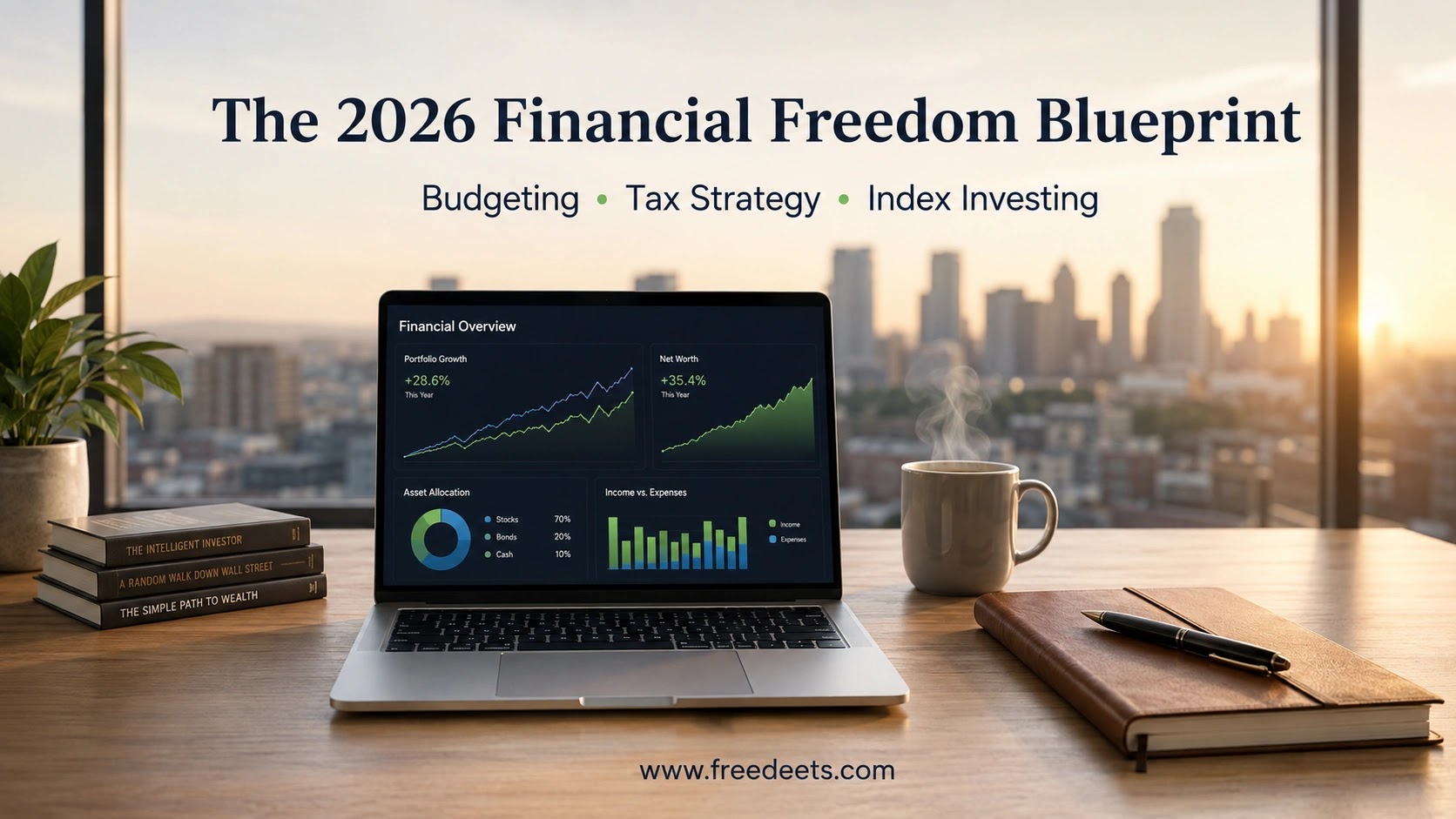
Personal financial security requires more than basic coupon-cutting. Research from the Federal Reserve Board indicates that millions of American households struggle to handle unexpected financial emergencies. Implementing a clear blueprint protects your family from unplanned expenses while systematically channeling surplus income toward compounding investment assets.
1. Auditing Your Current Financial Baseline
Before launching an aggressive investment plan, you must measure your starting position. A baseline audit reveals your true net worth and tracks how efficiently money moves through your household.
Calculating Your True Net Worth
Net worth serves as the foundational yardstick for evaluating your overall financial health. It uses a straightforward mathematical formula:
Net Worth Formula:
Net Worth = Total Assets (Cash, Investments, Real Estate) − Total Liabilities (Debts, Mortgages, Loans)
To calculate your baseline accurately, organize your finances into two main categories:
- Liquid Assets: Standard checking accounts, high-yield savings accounts (HYSA), and money market funds.
- Invested Assets: Employer 401(k) plans, Traditional and Roth IRAs, Health Savings Accounts (HSAs), and taxable brokerage accounts.
- Fixed Equity: Primary residence real estate equity and vehicle value.
- Current Liabilities: Credit card balances, student loans, auto financing, personal loans, and mortgages.
Measuring Cash Flow Velocity
Cash flow velocity examines how much of each paycheck is directed into wealth accumulation compared to non-essential lifestyle expenses.
| Cash Flow Category | Target Allocation (%) | Primary Purpose |
|---|---|---|
| Essential Needs | 45% – 50% | Housing, utilities, groceries, healthcare, baseline transport. |
| Wealth Building | 20% – 30% | 401(k), Roth IRA, brokerage investing, emergency reserves, debt principal. |
| Discretionary Wants | 15% – 20% | Dining out, travel, hobbies, personal subscriptions. |
| Tax Withholdings | Variable | Federal, state, and local payroll taxes. |
2. Implementing Proven Budgeting Frameworks
Rigid spending plans often break down because they fail to accommodate unexpected living costs. Two established budgeting models provide the flexibility required for consistent money management:
The Dynamic 50/30/20 Rule
This structure organizes your take-home pay into three practical categories:
- 50% Needs: Mandatory living costs including rent or mortgage, utility bills, food essentials, and minimum required debt payments.
- 30% Wants: Non-essential expenses like streaming entertainment, dining out, and travel.
- 20% Financial Growth: Surplus allocated toward accelerated debt elimination, index funds, and cash reserves.
Zero-Based Budgeting (ZBB)
For maximum cash efficiency, Zero-Based Budgeting ensures every earned dollar has a dedicated destination before the month begins:
Income − Expenses − Investments − Savings = 0
If your monthly take-home income is $6,000, your planned total across housing, living expenses, investments, and savings should equal exactly $6,000. This structural constraint eliminates unassigned spending.
3. Strategic Debt Elimination Within Your Personal Finance Blueprint
High-interest consumer debt remains the single largest hurdle to compounding wealth. Eliminating debt requires an organized plan that fits your financial profile.

The Debt Avalanche Method (Mathematically Optimal)
The Debt Avalanche targets debts based strictly on interest rates:
- List all open debts from highest Annual Percentage Rate (APR) to lowest.
- Maintain minimum monthly payments across every account to protect credit scores.
- Direct all remaining monthly surplus cash toward the highest-APR account.
- Once the balance is cleared, roll that full payment into the next highest APR debt.
Primary Benefit: Minimizes overall interest paid and shortens the mathematical timeline to debt freedom.
The Debt Snowball Method (Behavioral Focus)
The Debt Snowball organizes debts by balance size:
- List debts from smallest balance to largest balance, regardless of interest rates.
- Pay minimum requirements on all accounts.
- Funnel extra money toward paying off the smallest balance completely.
- Roll that freed-up monthly payment into the next smallest debt.
Primary Benefit: Builds quick psychological momentum through visible, early debt eliminations.
| Feature Metric | Debt Avalanche Method | Debt Snowball Method |
|---|---|---|
| Primary Objective | Minimizes total interest expenses | Builds behavioral momentum |
| Target Priority | Highest APR first | Smallest balance first |
| Payoff Timeline | Fastest mathematical outcome | Slightly longer total duration |
| Financial Savings | Maximum interest saved | Moderate interest saved |
4. Constructing a Resilient Multi-Tier Cash Reserve
An emergency cash reserve protects your long-term investments from premature liquidations during job changes or medical emergencies.
- Tier 1 (Operational Cash): Maintain roughly 1 month of normal living expenses in your checking account for routine billing cycles.
- Tier 2 (Core Emergency Fund): Keep 3 to 6 months of essential living expenses in an FDIC-insured High-Yield Savings Account (HYSA) with competitive interest rates and no maintenance fees.
- Tier 3 (Short-Term Capital Reserves): Store additional reserves in short-term Treasury Bills (T-Bills) or Certificates of Deposit (CDs) to lock in safe yields.
5. The Tax-Advantaged Investment Waterfall
To maximize compounding efficiency, follow an orderly investment waterfall that exhausts tax-advantaged options before using standard taxable accounts.
1. Capture the Full Employer 401(k) Match
If your company offers a 401(k) match, contribute enough to capture the complete employer portion. This represents an immediate, guaranteed return on your contributions.
2. Maximize Health Savings Account (HSA) Contributions
If enrolled in an eligible High Deductible Health Plan (HDHP), an HSA provides triple tax advantages:
- Contributions are tax-deductible from gross income.
- Investment growth and dividends compound tax-free.
- Withdrawals for qualified medical expenses are completely free of tax.
3. Roth IRA vs. Traditional IRA
Consult guidelines from the Internal Revenue Service (IRS) regarding current annual contribution and income limits:
- Roth IRA: Funded with post-tax dollars. Investment gains and qualified withdrawals in retirement are entirely tax-free.
- Traditional IRA: Contributions may reduce taxable income today, and balances grow tax-deferred until retirement withdrawals are taxed as ordinary income.
4. Broad-Market Index Investing
Once tax-sheltered accounts are maximized, funnel remaining investment dollars into low-cost index funds within a taxable brokerage account. Total market and S&P 500 index funds offer strong tax efficiency and low annual expense ratios.
6. Asset Allocation Models by Timeline
Diversifying across asset classes reduces portfolio volatility throughout economic cycles:
| Portfolio Model | Equities (Stocks) | Fixed Income (Bonds/T-Bills) | Real Estate / REITs | Target Horizon |
|---|---|---|---|---|
| Aggressive Growth | 85% – 90% | 5% – 10% | 5% | 20+ years; high risk tolerance |
| Balanced Growth | 60% – 70% | 20% – 30% | 10% | 10–20 years; moderate risk tolerance |
| Capital Preservation | 30% – 40% | 50% – 60% | 10% | Near retirement; conservative |
Frequently Asked Questions About Personal Finance
How much should I keep in an emergency fund?
Most individuals should keep 3 to 6 months of essential living expenses (housing, utilities, groceries, and debt payments) in an FDIC-insured High-Yield Savings Account. Self-employed workers or single-income households should consider holding 6 to 12 months of expenses.
Should I pay off debt or invest first?
First, secure any available employer 401(k) match. Next, prioritize eliminating high-interest debt (anything above 7% to 8% APR). Once high-cost balances are paid off, channel surplus cash into broad index funds while making steady payments on low-interest debt like fixed mortgages.
What is the 4% Rule in retirement planning?
The 4% Rule suggests that a retiree can safely withdraw 4% of their total investment portfolio during their first year of retirement—adjusting for inflation annually thereafter—with a very high probability of maintaining portfolio solvency over a 30-year horizon.
Core Takeaways for Financial Freedom
- Audit your baseline net worth and cash flow before investing.
- Eliminate high-interest debt using either the avalanche or snowball method.
- Follow the investment waterfall: 401(k) match, HSA, Roth IRA, then index funds.
Conclusion
Executing a consistent personal finance blueprint leads to sustainable wealth accumulation without speculative risk. By auditing your cash flow, managing debt efficiently, and maximizing tax-advantaged retirement accounts, you establish a resilient foundation for long-term financial security.